Tag: Psychological

  • Where Death is a Hunter

    Where Death is a Hunter

    Where Death is a Hunter

    Recommended Age: 16+

    Warnings: Character Death, Surgery, Mild Violence, Mentions of Alcoholism / Hallucinations

    Pages: 371 (Paperback)


    Christopher Stookey’s Where Death is a Hunter was recently sent to me by Full of Books to review. As with most of my readings assigned for review, I enjoyed the book more than I expected to.  As an avid YA-Fiction fan, I rarely decide to read books from other genres – especially medical thrillers. However, I definitely enjoyed the change in genre, even for just one book.

     Hannah Fatier has just started her first job as an anesthesiologist at Deaconess Hospital in San Francisco, she has just bought a new home, and she is newly engaged. In short, Hannah’s life is going well. That is, until a patient under Hannah’s care dies of mysterious causes during a routine operation. An investigation of the case reveals the cause of death to be a basic medical error that Hannah seems to be responsible for. When she decides to dig deeper into the records concerning the case, Hannah discovers a number of puzzling inconsistencies. She begins to suspect that someone has framed her for the death of her patient, but who? And more importantly, why?

    Let me get this straight: I consider myself to be a ‘scaredy-cat’. I jump easily at horror films, don’t enjoy “scary” activities, and hate seeing blood and gore. However, the medical and thriller aspects of this book didn’t bother me at all. I enjoyed the fact that the book included facts and statistics, which provided further insight to the medical world. (For example: did you know that at least 44,000 people die in hospitals each year because of medical errors?) The plot did not drag back or rush ahead; it moved at a perfect pace. The big reveal of ‘whodunit’ is an unexpected plot twist, and the novel has a strong conclusion. The only drawback is the fact that there was almost no character development. Hannah does learn that she cannot trust everyone, but there is no big realization or change from the beginning to the end of the book.


    Views: 2

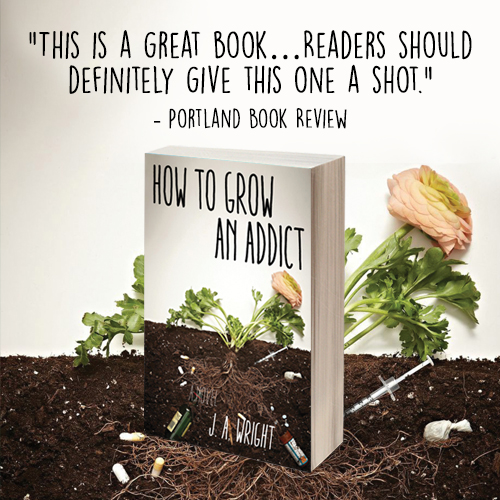
  • How to Grow an Addict

    How to Grow an Addict

    How to Grow an Addict by J.A. Wright is a page turner without a doubt. From the very first page, you’re drawn into the main character Randall Granges world and how her story will end.

    Randall’s story is a heartbreakingly beautiful one. From getting drunk at the age of 10 to being 23 and full blown addict on her way to recovery. I personally was drawn to the way Wright shows weak moments in Randall’s life and why she felt the need to reach for alcohol or pills. Wright does an amazing job of showing Randall’s progression in being an addict. Coming from a dysfunctional family In no way helped her but she (at least for a while) had her Aunt Flo and Uncle Hank until tragedy strikes. Going to her aunt and uncles house really kept Randall busy and away from her home troubles. It was sad to see Randall return back home with her mother, father, and brother.

    I feel as though Randall’s father was the biggest contributor to her addiction. At the age of 10, at a birthday he serves her whiskey, getting her drunk for the first time. Now although she did have her mother, she wasn’t in any way a great mom. She was never emotionally there for Randall and would give her sleeping pills because it was convenient which ultimately led to Randall’s addiction to narcotics. Now, her brother Robbie never helped her with anything and blamed her for everything. He treated her awful even though Randall was there for him always and looked up to him.

    One can understand why Randall felt the need to depend on something to make her feel better or take her mind off things. Near the end, we’ve learned a lot about Randall and can’t help but want to run up to her and give her a hug she so desperately needs. From being sexually harassed more than once to being in an abusive relationship and not having a support system, you want to tell Randall that maybe she doesn’t know it now but everything is going to be fine.

    As How to Grow an Addict comes to a close, we find Randall has been involuntarily put into a rehab institution. Of course, she wakes up there and wants to immediately leave, but the more time she spends there and the more people she talks to, she has a new sense of wanting to change her life around. Ultimately in this life and what I learned from this book is that sometimes you get chances to fix your life and it’s up to you to jump on them. This book brings you on a beautiful but tragic journey of a girl who couldn’t find her way in the beginning but gets a second chance at life and gets a retry, something she so desperately needed. I think the message of this book is to learn from your mistakes. Randall made many mistakes and paid for them, but what How to Grow an Addict shows is that you learn from mistakes and thankfully Randall did learn.

    Rating: 4 out of 5

    Views: 5

  • Anatomy of an Epidemic

    Anatomy of an Epidemic

    Having watched one friend after another succumb to the lure of Prozac, and the irresistible argument that it’s a chemical imbalance that’s responsible for all their problems (and not their difficult marriage, family circumstances or financial straits) – I’ve been searching for a book to finally put the whole ‘chemical imbalance’ debate to bed, once and for all.

    If it exists, it must be provable, scientifically, and that information must be out in the public domain somewhere.

    Sadly, the more I’ve been trying to find this proof, the clearer it’s becoming that the Loch Ness Monster is actually more of a fact than the ‘chemical imbalance’ theory of mental illnesses.

    The latest nail in the coffin has been Robert Whitaker’s investigative masterpiece: Anatomy of an Epidemic: Magic Bullets, Psychiatric Drugs, and the Astonishing Rise of Mental Illness in America.

    Whitaker is a seasoned journalist of many years’ standing, who went looking for an answer to the question: Do people taking psychotropic medications have a better quality of life over the long term?

    He reasoned that if drugs like Prozac, Xanax, Abilify, Zyprexa, Adderal – and all the rest of them – really were ‘solving’ the problems causing mental illnesses, as claimed by groups like the American Psychiatric Association (APA) and of course, the pharmaceutical companies themselves, that should be showing up in much better long-term outcomes for patients who are taking their pills.

    Whitaker spent a couple of years trawling through thousands of medical records, research studies and clinical trials to come to the stunning conclusion that not only are psychiatric drugs failing to provide any long term benefit to users, in many instances they are actually leading to even worse outcomes.

    To quote just a couple of the more eye-opening findings from the book: Before the advent of psychopharmacology, around 76% of schizophrenic patients recovered by themselves, and went on to live productive lives, with around 50% never experiencing another psychotic break. By contrast in more modern times, only 5% of the schizophrenia patients who stayed on the drugs they were prescribed by their psychiatrists recovered enough to hold down a job and re-integrate into the communities.

    In another chapter, Whitaker explained how the infamous ‘chemical imbalance’ theory has never been proved for any mental illness – despite 30 years’ of research – and told the story of a group of 6 ‘survivors of psychiatric drugs’ who went on a hunger strike in 2003, to try to force the APA into releasing the evidence they claimed to have proving the chemical imbalance existed.

    The APA never responded.

    And yet, this hasn’t stopped psychiatry building ever taller castles in the sky about how they can ‘diagnose’ increasing numbers of mental illnesses (around 350, by the last count) and ‘cure’ them by prescribing the right little pill.

    One more piece of information: regular use of psychotropic medication has been proven to shorten patients’ lives by between 15-25 years on average – thanks to all the side effects that no-one really talks about, but that plenty people are still suffering very badly from.

    Whitaker remains clinical and detached throughout, throwing in one additional fact, one extra scientific study, one more personal story after another, to carefully build his solid edifice of proof that the drugs don’t work.

    By the end of Anatomy of an Epidemic, I literally felt sick to my stomach about the amount of deception, bogus science, greed and personal suffering woven into the whole sordid tale of psychiatric medicine.

    I couldn’t help wondering about the dubious mental state of all the doctors and shrinks who are busy herding their trusting patients on to more and more meds, without telling them about all the side-effects, drawbacks and long-term suffering they are potentially letting themselves in for. Not for the first time, it struck me that in 2016, the lunatics really have taken over the asylum.

    Anatomy of an Epidemic is beautifully written, but is not easy reading – particularly for those who still want to believe that their ‘chemical imbalance’ is the true source of their misery. But for anyone who wants to know the truth about psychotropic medications, and who wants to be reassured that drugs are NOT the route to happiness and wellbeing, and who wants to have the facts they need to debunk the many myths being told about what’s causing mental and emotional issues and how best to resolve them, Anatomy of an Epidemic is one of the very best out there.

    Views: 10